Esther
Summary of book:
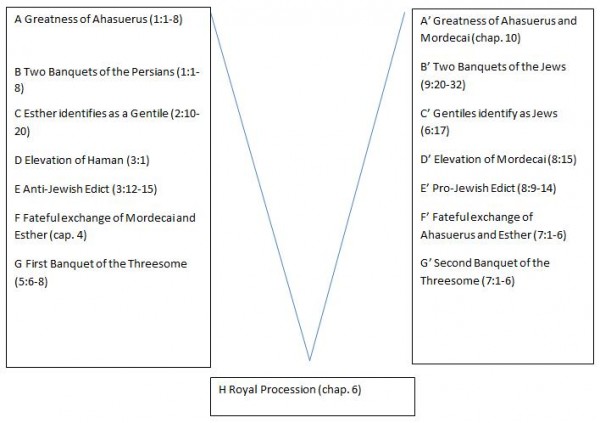
It is maintained that this book is historical. This book is many things and it would be a mistake to view it from just one angle. It is for example a tale of intrigue at court, a story of lethal danger to the Jews narrowly averted by heroic rescue. It is also a tale of the ascent of an orphan in exile to the rank of the most powerful woman, in the powerful empire. It is a story of how a humiliated and endangered minority, the Jews living in Diaspora after the Babylonian exile, came to be respected and feared by the Gentile majority and to see one of their own to be honoured with the position of the second most important person in the Empire. It is the comical story of a pompous fool who does himself in, and the chilling tale of the narrow escape from death of a despised and vulnerable minority. One way to view the structure of the narrative is in terms of ten banquets, that is, five sets of two. The following diagram demonstrates a pattern of symmetry to the book, with chapter 6 being the pivot chapter where the exchange of status between Haman and Mordecai happens.
Vital Statistics
- Purpose
The practical objective of this book in its surviving Hebrew form is to authorise and regulate the Feast of Purim, which is a two- day celebration marked by festive banqueting.
- Author
The Book of Esther is anonymous. The most popular traditions are Mordecai (a major character in the Book of Esther), Ezra and Nehemiah (who would have been familiar with Persian customs).
- Dating
There are many opinions as to the date of the book. While we can’t be certain of its date, it is suggested that the whole story takes place in the 5th century B.C.
- Setting
The story takes place in the Persian Empire. This was the greatest empire before the Romans and it lasted for two centuries. Persia conquered Babylon in 539 B.C. What happens in the book took place between the return to Jerusalem of Zerubbabel and the return of Ezra some 80 years later. The Ahasuerus in this book is the Xerxes of the secular history and a lot is known about him outside of the Scripture.
Other reflections:
Exile: The Jews in this book are in exile, and yet one surprising aspect of the political thinking of the book is its complete lack of interest on the land of Israel. This book does not include any vision of the overthrow of the foreign power. This book is a legacy of Persian Jewry and reflects a stratum of society with a very different understanding of Jewishness from that of comparable literature.
God’s presence: The name of God is never mentioned and yet the hand of God is visible.
Key Verses
“Mordecai the Jew was second in rank to King Xerxes, pre-eminent among the Jews, and held in high esteem by his many fellow Jews, because he worked for the good of his people and spoke up for the welfare of all the Jews”. (10:3)
Key Questions
How can we recognise God’s hand in circumstances that might seem just a coincidence? Is God in control, working out his plan, no matter what the situation?